

Collaborative Process
The process engages a diverse range of stakeholders to gather feedback, make shared decisions, and build an energy efficiency workforce.

The Project Review Committee includes staff representatives from the City of Lincoln and Lancaster County.

This plan will include public engagement to inform City and County residents and taxpayers about the planning process and recommendations.

City and County maintenance and operations personnel are being interviewed to understand challenges and opportunities related to building operations. They are also providing information about building systems and conditions to inform the energy analysis and recommendations.

Union workers from IBEW Local 265 and students from Southeast Community College are assisting with facility condition assessments and audits. Their involvement supports the goal of building a future energy efficiency workforce.
The planning process combines building analysis with stakeholder feedback to understand the existing emissions baseline and recommend a path forward.
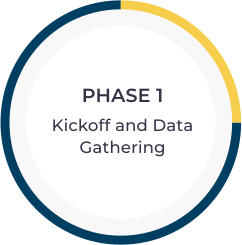
The team gathers data about buildings owned and operated by the City of Lincoln, Lancaster County, and the PBC, and their gas and electric utility consumption, to calculate the baseline energy use of each major facility. Initial tours of major buildings and interviews with facilities managers for each City/ County department provide context on how buildings are managed and operated.
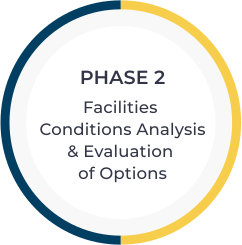
The team inspects each major building owned and operated by the City of Lincoln, Lancaster County, and the PBC. Inspections evaluate:
Interviews with key facilities personnel during inspections identify additional challenges and opportunities related to energy efficiency and operations. Based on the data gathered, a decision-making tree recommends the level of improvement needed at each building. Aligned with the level of improvement is a targeted energy efficiency goal to reduce energy consumption on the demand side. Renewable energy generation opportunities are also explored on the supply side. Analysis of interviews informs operational recommendations, like behavior changes, policies, and budgeting practices, that will support energy efficiency and renewable energy generation.
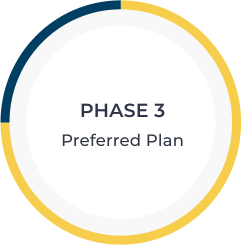
Based on the analysis and inventory from Phase II, a scenario is finalized for municipal buildings to achieve carbon neutrality by 2035. Recommendations address energy efficiency upgrades at major facilities, operational and behavior changes, and procurement of renewable energy sources or carbon offsets to meet the targets on the supply. When recommendations are finalized, the team investigates potential funding and financing strategies to achieve the recommendations and determines how progress will be measured throughout the implementation process.
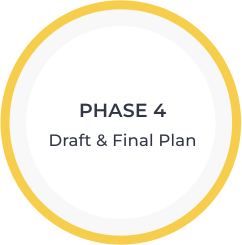
The team drafts and finalizes the public-facing EMP website, as well as the internal EMP dashboard that will be used to monitor and track the progress of municipal facilities towards achieving carbon neutrality.



