
kEY fINDINGS

Building Assessment Key Findings

These findings are related to the physical conditions, characteristics, and energy use of municipal buildings.

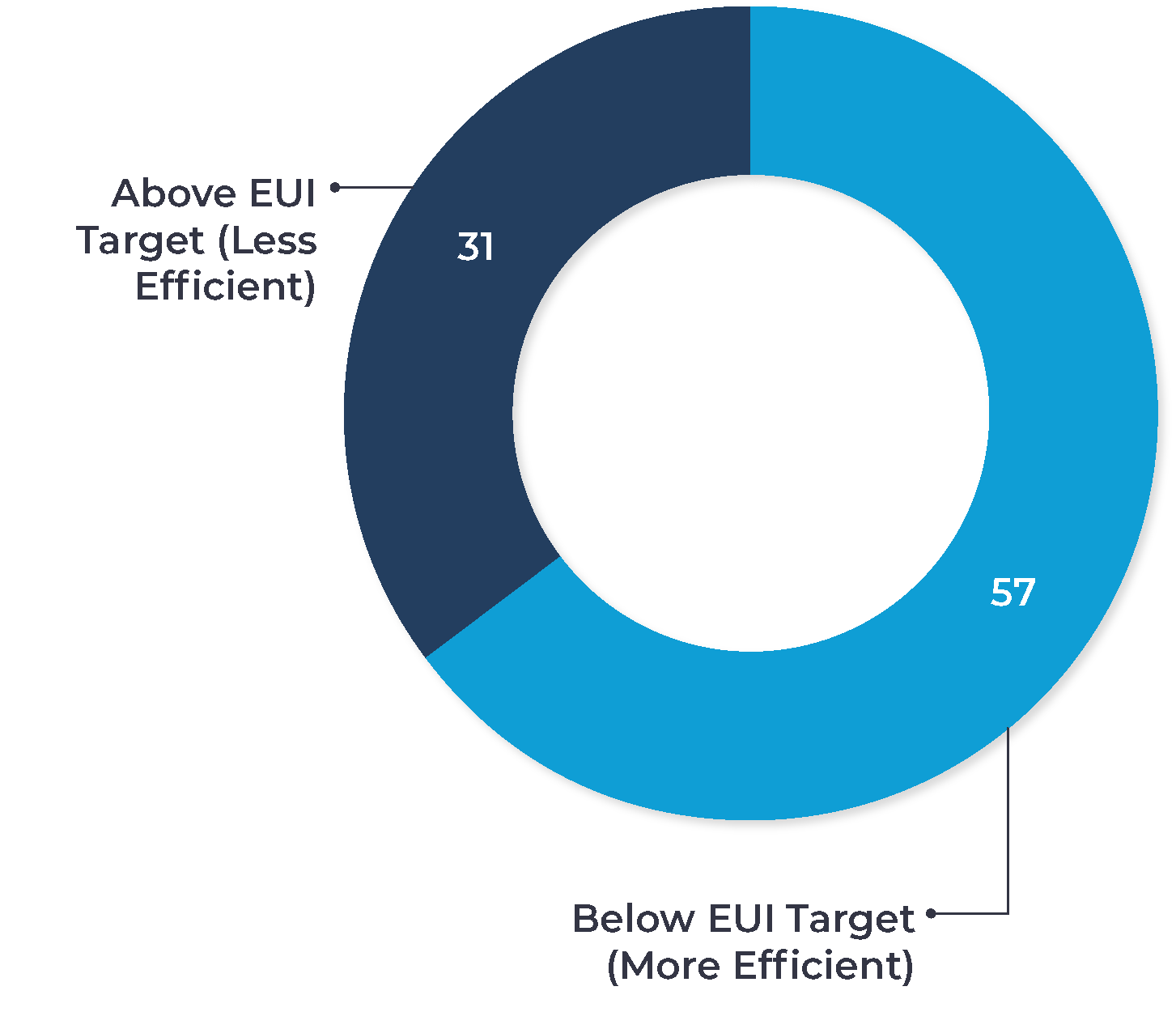
Note that while the baseline energy use intensity was measured for all 88 buildings included in this plan, building assessments were performed for 59 buildings. 
KEY FINDINGS
WHAT IT MEANS
1
VARIED ENERGY CONSUMPTION

One third of municipal buildings have Energy Use Intensities (EUIs) exceeding their American Society of Heating, Refrigerating, and Air-Conditioning Engineers 100 (ASHRAE 100) benchmarks, which is a standard that sets energy efficienct requirements for existing buildings to reduce energy use and improve performance. This means these municipal buildings are using more energy than the median for a building of their size and type.

Buildings with an EUI above the ASHRAE 100 EUI target have a greater opportunity for energy reduction measures to meet the goal of carbon neutrality.
Overall Building Portfolio Energy Rating
    One third of the buildings in the overall portfolio are using more energy than the median for a building of their size and type according to ASHRAE 100 benchmarks.
    2
    VARIED HVAC CONDITIONS

    Of the factors contributing to heating, ventilation, and air conditioning (HVAC) conditions, air side systems and heating plants showed the most room for improvement. Cooling systems showed better conditions on average.

    HVAC systems are one of the most significant contributors to a building’s energy use. Inefficient HVAC systems can cause a building’s energy use intensity to increase.
    HVAC conditions were evaluated based on:
    Age of HVAC and water heater equipment

    Typical heating, ventilation, and air conditioning (HVAC) equipment (i.e. heat pumps, air conditioners, furnaces, fans) has an average life expectancy range of 15 to 20 years per ASHRAE Equipment Life Expectancy. As equipment ages it becomes less efficient and can result in higher energy bills.
    A blue and yellow icon of a leaf within an outlet circle
    HVAC and water heater equipment efficiency

    High efficiency equipment was given a higher grade and lower efficient equipment was assigned a lower grade. High efficiency equipment is more effective at heating and cooling and uses less energy.
    Where appropriate, the use of energy recovery ventilator

    HVAC systems that utilized energy recovery ventilators and appropriate conditioning of outside/ventilation air had better conditions as these methods reduce overall energy consumption in a building. Energy recovery ventilators exhaust air from areas requiring exhaust air, such as restrooms janitor closets, while providing outdoor air to maintain good indoor air quality. An energy recovery ventilator transfers the energy between the exhaust air stream and preconditions the outdoor air. Further dehumidifying or heating of the outside air provides a comfortable indoor environment for the occupants.
      3
      VARIED BUILDING ENVELOPE CONDITIONS

      Window defects are the biggest contributor to lower building envelope conditions. For example, various buildings assessed had opportunities to replace old, single-pane, non-thermally broken windows, and/or windows with broken glazing seals, resulting in poor energy performance.

      Building envelope condition affects the amount of heat transferred between the inside and outside of a building. When buildings are not properly sealed, insulated, oriented, or shaded, more energy is consumed to keep the building at a comfortable temperature for occupants.
      Envelope conditions were evaluated based on:
      Makeup of exterior walls and roof – insulated

      A well-insulated building envelope contributes to lower energy consumption and a higher assessment grade.
      Glazing - double vs single pane windows

      Single-pane, non-thermally broken aluminum windows contribute to increased energy use in conditioned buildings and therefore would result in a lower grade in this assessment. Double pane windows thermally broken windows contribute to increase thermal performance and decrease energy usage.
      Envelope tightness – infiltration, sealant

      A well-sealed building envelope contributes to lower energy consumption and a higher assessment grade.
        4
        THERMAL CONTROLS AND SETBACKS

        Many buildings do not have automated temperature set points or controls to adjust thermostats at night or when buildings are not being occupied.

        A lack of thermal controls and automated setbacks leads to more energy being consumed heating and cooling buildings when they are not in use, and occupant discomfort when thermostats are not set to a comfortable range. 

        Operational Key Findings

        These findings relate to the practices and policies that impact how buildings are operated, energy use, and energy efficiency across City departments and the County. Through interviews with facilities managers for each City and County department, the following opportunity areas were identified. 

        KEY FINDINGS
        WHAT IT MEANS

        1
        INCONSISTENT ENERGY EFFICIENCY SUCCESSES
        Some municipal buildings have already implemented energy efficiency measures like geothermal energy, solar panels, and LED lightbulb replacements, but there is not yet a consistent strategy for prioritizing and implementing these across the portfolio.
        Strategies that are already working for the City and County can be good case studies to learn from and expand across municipal buildings as part of this plan. Prioritizing energy efficiency measures first can help reduce the amount of energy that must be generated from renewables to achieve net zero. 

        2
        REACTIVE VS. PREVENTATIVE MAINTENANCE
        Fiscal constraints, significant deferred maintenance, and varied tracking of building systems and equipment make it challenging to perform preventative maintenance that may improve energy efficiency; maintenance and capital improvement budgets are often prioritized towards immediate operational and safety needs.
        Preventative maintenance can help identify energy inefficiencies before building systems fail. It provides enough time to plan for the replacement of aging systems with more energy efficient alternatives. There are opportunities for additional funding and asset management systems to support proactive maintenance.

        3
        STAFF TRAINING AND SUPPORT
        Existing building managers and maintenance staff have received varied training and support around energy efficiency best practices for the operation and maintenance of building systems.
        Training can help empower existing staff to consider energy efficiency in their everyday roles and tasks. 

        4
        STAFF CAPACITY
        Some City departments do not have dedicated building manager and maintenance staff positions, making it challenging to track maintenance needs and perform preventive maintenance.
        When building management and maintenance is not an explicit role, more immediate operational needs and duties can supersede maintenance needs. Dedicated building managers can help ensure proactive maintenance and monitoring of energy efficiency. 

        5
        PROCUREMENT ALIGNMENT
        There is an opportunity for more alignment around procurement decisions, like standards for unit contractors, building systems, and new construction and renovation of municipal buildings that center energy efficiency and net zero best practices. These procurement standards do not currently exist.
        Standards can create clear expectations and accountability for major decisions related to municipal buildings, supporting staff in prioritizing energy efficiency.